In recent years, the asylum system in the United States has changed dramatically. What was once a system dominated primarily by single adults has gradually transformed into one marked by the arrival of families with children, who have come to represent a significant, and in many periods, majority of those seeking international protection. This shift not only reflects a change in migration patterns but also a new humanitarian reality: asylum has ceased to be an individual phenomenon and has become a family phenomenon, in which children play a central role.
Although asylum and refugee status are based on the same definition of persecution established by the 1951 Convention, they are not identical in their application. In legal terms, both those who obtain asylum and those recognized as refugees share the same condition: they are individuals who require international protection because they cannot return to their country without risking their life or liberty. According to the 1951 Convention Relating to the Status of Refugees, this implies having a well-founded fear of persecution based on race, religion, nationality, political opinion, or membership in a particular social group.
The difference, therefore, lies not in who the person is or in the nature of the risk they face, but in the time and place from which they request that protection: refugee status is processed outside the country of destination, while asylum is requested within the United States or at its border.
This legal framework helps explain why thousands of children and families arriving at the border cannot be seen solely as immigrants but as potential refugees seeking protection from real risks of persecution and violence. However, their recognition depends on an increasingly restrictive, overburdened, and inaccessible asylum system, where waiting times, administrative decisions, and changes in immigration policy can leave thousands of minors in a prolonged state of uncertainty, trapped in processes that do not guarantee a swift or safe resolution.
Fiscal year 2025 marked a turning point in this scenario because, with the tightening of immigration policies and the reduction of encounters at the southern border, there was a significant drop in the arrival of families with children seeking asylum, which modifies the composition of the system and redefines its scope.
The progressive closure of border access mechanisms presents a new scenario: fewer families are entering the system, but those who do face greater barriers and a more restrictive environment.
Against this backdrop, this research analyzes how children have become the most visible component of the family-oriented nature of the asylum system in the United States, how many families have actually entered the system between 2022 and 2025, and what impact the drop in migration flows in 2025 has had, with the aim of understanding whether this option continues to respond to a family reality or whether, on the contrary, new policies are transforming its structure and leaving thousands of children in a migratory limbo.
To do this, I will cross-reference data from the Office of Homeland Security Statistics (OHSS) based on data from the Department of State (DOS), the United States Citizenship and Immigration Services (USCIS), the United States Customs and Border Protection (CBP), and in some necessary cases, due to the absence of data, I will project data that will allow us to approximate the reading of possible scenarios.
Until 2024, one in two refugees was a child
Let's analyze how the refugee system was behaving until 2024 to understand what happened in 2025, after the closure and the drop in the arrival of immigrants; until that year the system was no longer mainly housing single people but was receiving families.
According to the Office of Homeland Security Statistics (OHSS), based on data from the Department of State (DOS), in 2024 many people admitted as refugees did not arrive alone, but accompanied by their families. The data clearly showed this:
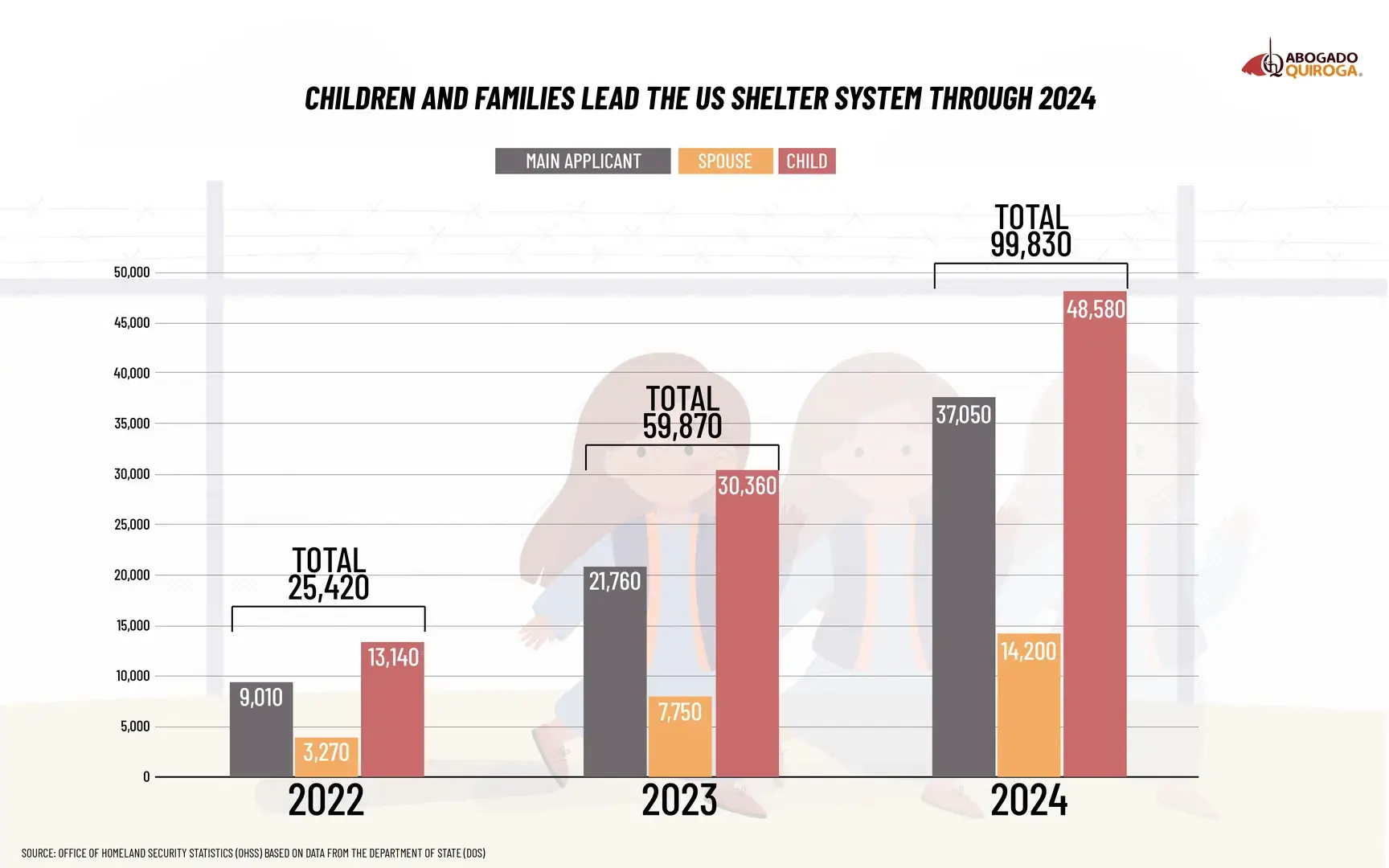
The number of refugees admitted to the United States grew rapidly between 2022 and 2024, but, beyond the increase, the data shows something deeper: the profile of those arriving hardly changed.
According to the Office of National Security Statistics, the system not only expanded, but maintained a very clear structure where many cases continued to involve families, and within them, children occupied the central place:
-
2022: 25,520 refugees
-
2023: 60,050 (almost triple)
-
2024: 100,060 (an increase of nearly 66% compared to 2023)
This means that, in just two years, the program almost quadrupled. However, this increase was not accompanied by a change in its composition; children continued to be the largest group, although their numbers decreased slightly.
-
51.5% in 2022
-
50.6% in 2023
-
48.6% in 2024
In theory, the data shows that until 2024, one in two refugees was still a minority, but at the same time, other groups grew:
-
Spouses increased from 12.8% to 14.2%, from 2022 to 2024
-
The percentage of primary applicants rose from 35.3% to 37% between 2022 and 2024.
These changes, although small, allow us to conclude that more and more families were managing to migrate together, not just with one of the parents, and if we look at the overall picture, the trend is clear:
-
Families (spouses and children) represented:
-
64.3% in 2022
-
63.5% in 2023
-
62.8% in 2024
Overall, the data show that the system continues to be dominated by family reunification dynamics, with almost two-thirds of the beneficiaries being direct relatives, but with a trend towards a more balanced composition between adults and minors.
2025: Fewer arrivals, but more families trapped
While there are no official consolidated figures on the performance of the U.S. refugee system for fiscal year 2025, it is possible to make a rough projection of the potential impact of these figures based on the trend observed between 2022 and 2024 and the recent context of stricter immigration policies. The reduction in the flow of people seeking international protection and the new control measures have led to a slowdown in the number of families entering the system, suggesting a decrease in the total number of applicants for that year.
In this context, the projection for 2026 is built on the historical behavior of the international protection system and the evolution of the family composition of applicants, where children continue to represent the majority group, followed by the main applicants and spouses.
This projection, based on an intermediate scenario of 50,000 asylum seekers, shows that the U.S. asylum system maintains a distinctly family-oriented structure, with children continuing to be the most represented group at 49% of the total. This confirms that protection is not focused on individuals migrating alone, but primarily on families seeking safety. In most cases, an adult files the application and includes their partner and children in the process, demonstrating that asylum primarily functions as a means of protection for entire families.
Children have become the main face, which implies greater humanitarian, legal and institutional challenges, especially in terms of protection, response times and capacity to care.
US asylum applications: children and families marked the biggest increase until 2023
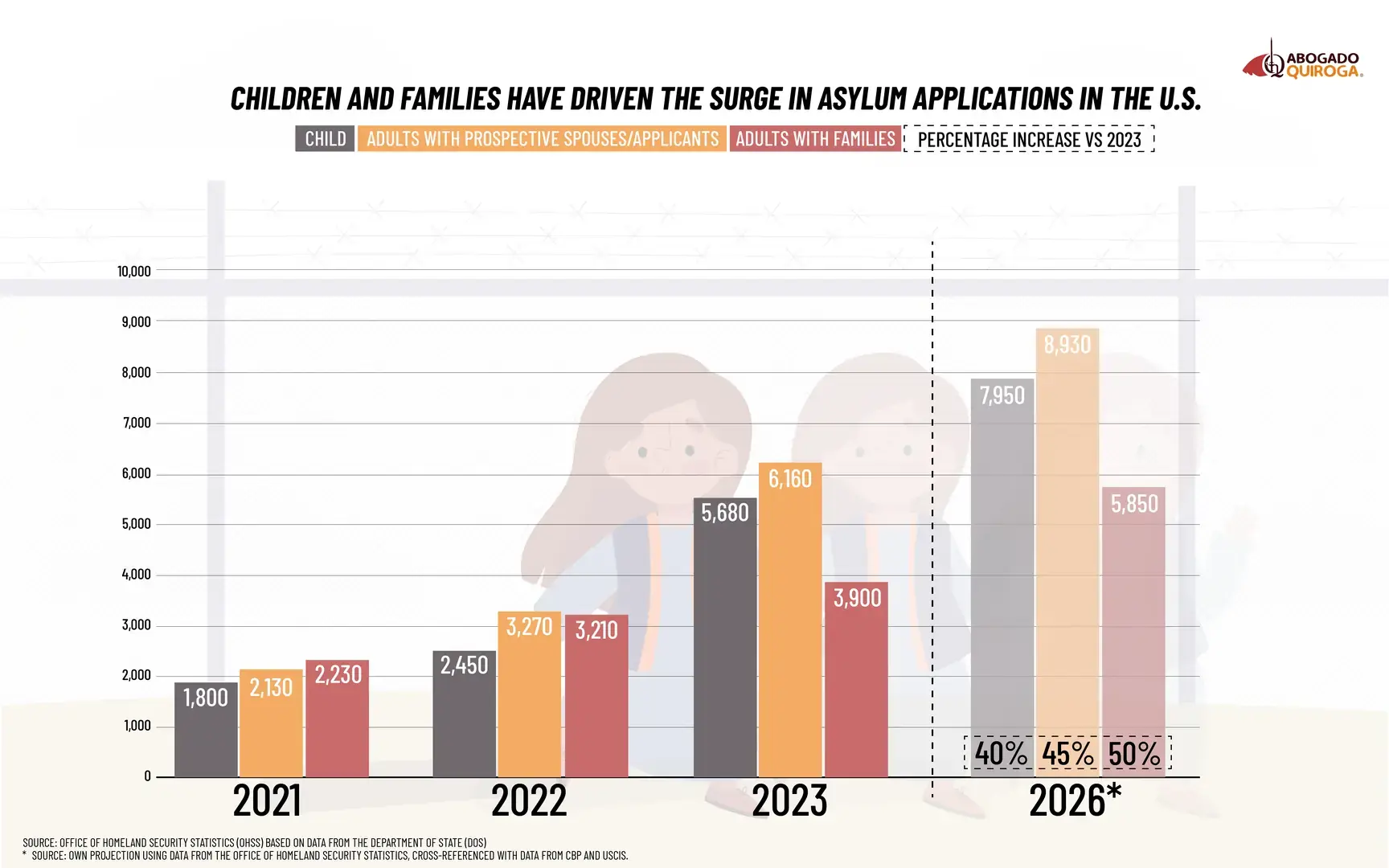
According to the Office of Homeland Security Statistics (OHSS), the most recent data reported is between 2021 and 2023. In this range, the flows of people registered or applying in the United States showed sustained and significant growth, with a particularly notable increase in the groups of minors and entire families.
The data reflects a change in the profile of those seeking protection or regularization, with an increasingly marked presence of children and adults linked to family units.
Although asylum statistics are not always directly broken down by age, the growing presence of family units and referred cases demonstrates the weight of minors within the system.
Let's focus on the data reported during these three years:
-
Children
-
2021: 1,800 cases
-
2022: 2,450 cases (a 73% increase compared to 2021)
-
2023: 5,680 cases (a 43% increase compared to 2022)
This shows us that the number of minors tripled in two years, becoming an increasingly relevant group within the records.
-
Adults with prospective spouses or applicants
-
2021: 2,130 cases
-
2022: 3,270 cases (a 65% increase compared to 2021)
-
2023: 6,160 cases (a 53% increase compared to 2022)
This group also shows a sustained increase and almost tripled in two years.
-
Adults with families
-
2021: 2,230 cases
-
2022: 3,210 cases (a 69% increase compared to 2021)
-
2023: 3,900 cases (an 82% increase compared to 2022)
Complete families saw a notable increase in 2023 and the highest percentage growth among all groups, demonstrating an accelerated flow of family units in the United States.
USCIS data shows that asylum applications are still coming in
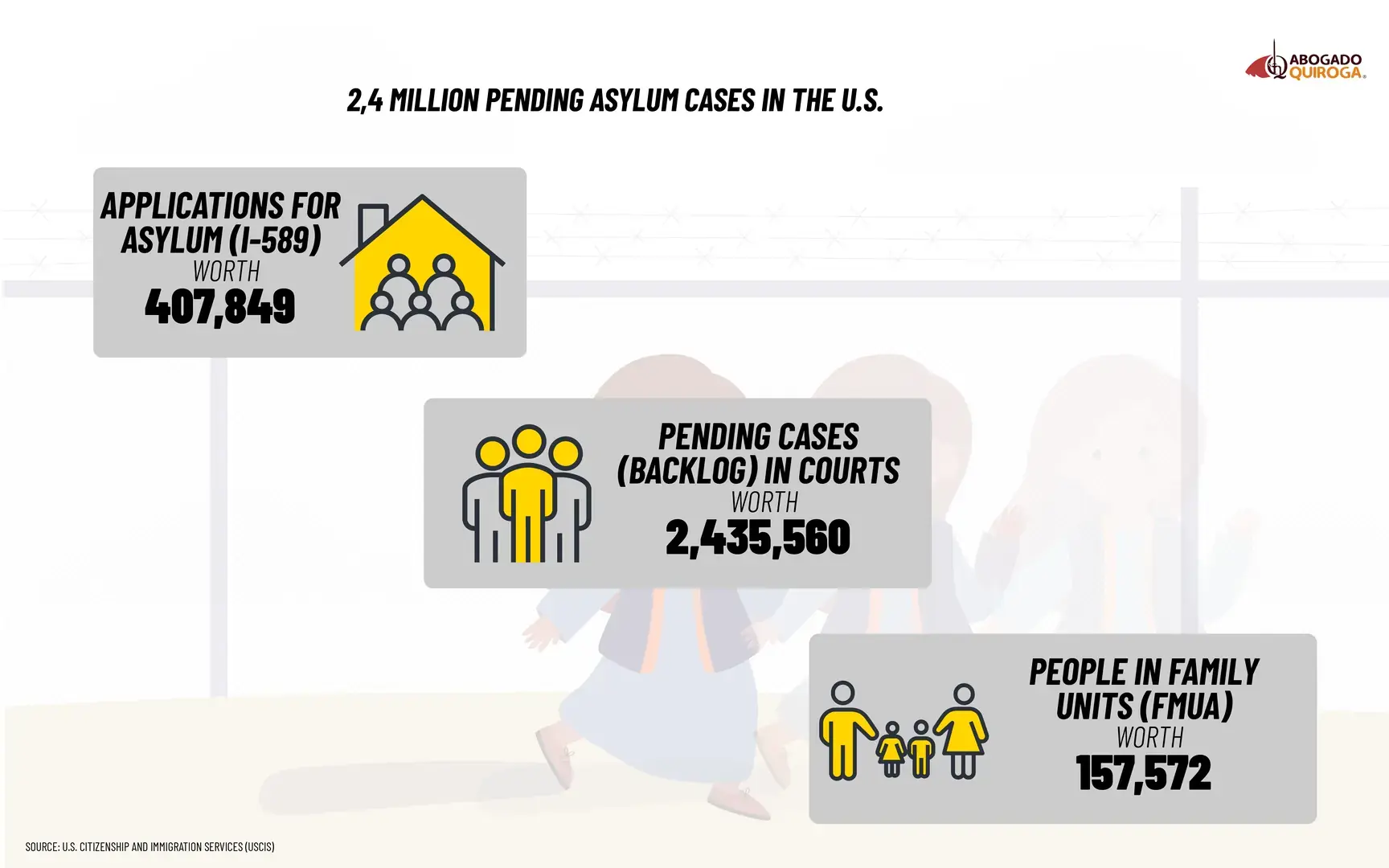
According to data from the United States Citizenship and Immigration Services (USCIS), the I-589 form is the document used to make the formal asylum application. This form is submitted by the principal applicant, usually one of the parents, and can include their spouse and children under 21 years of age in the same application.
Although the Trump administration declared, through an order of January 20, 2025, that the situation at the southern border constituted an invasion of the United States and that it suspended the physical entry of migrants and their possibility of requesting asylum, the US judicial system stopped this measure, so in 2025 immigrants were still arriving at the border in search of protection, although to a lesser extent.
According to the United States Citizenship and Immigration Services (USCIS), the following were registered for fiscal year 2025:
-
407,849 asylum applications
-
1,435,560 pending cases
And at the same time, figures from the Customs and Border Protection Office (CBP) show a drop in family flow in the figures reported during the fiscal year.
-
157,572 people in family units (FMUA)
-
1,662 UAC (unaccompanied minors)
This reveals a clear shift in dynamics: while the visibility of families driven by the expansion of the asylum system predominated until 2023, by 2025 the logic had changed. Although arrivals at the US border decreased, the internal backlog of cases increased, expanding the number of families waiting to nearly 1.5 million pending cases.
Taken together, both the data from the refugee program and the trends observed in the asylum system show a consistent pattern: the presence of children and families is not marginal, but structural. Although registration methodologies differ between systems, the evidence suggests that international protection in the United States is increasingly being sought by families, with children as the most visible and vulnerable group.
Children and families at the limit: asylum applications in the US are projected to skyrocket by 2025
It is important to clarify that the asylum system in the United States operates through two distinct pathways: affirmative asylum, processed by U.S. Citizenship and Immigration Services (USCIS), and defensive asylum, which is resolved in immigration courts. Both routes are part of the protection system, but they respond to different dynamics and volumes, so their figures are not directly comparable.
In 2025, the asylum system in the United States reached historic levels of pressure: nearly 875,000 new applications entered the immigration court system – defensive asylum – (25% more than those registered in 2024), while the number of pending cases exceeded 2.4 million, showing that the crisis is no longer just at the border, but in the system's inability to process the demand.
Regardless of the tightening of immigration policies, hundreds of people cross the border in search of safety, and current trends suggest a scenario in which:
Children: It is estimated that almost 8,000 minors were part of the asylum applications, representing a 40% increase compared to 2023.
Adults with potential spouses or applicants: More than 8,900 adults, or 45% more than in 2023, sought protection together with their partners or family members.
Adults with families: Approximately 5,850 adults traveled with their entire families, reflecting a 50% increase. compared to 2023, demonstrating that entire families continue to be an important group within the system.
More than a change in flows, what the data reveals is a structural transformation: the protection system in the United States is no longer defined by isolated individuals, but by families, and within them, children have become its most visible and also most vulnerable expression.
For more statistics, click here to see all the information.