

For millions of immigrants, arriving in the United States means much more than crossing a border; it is the search for stability, better income, and opportunities that they did not find in their countries of origin. But that promise also comes with a more complex reality: entering a labor market where they do not always have the same conditions or the same protections.
Many of those who arrive end up occupying the hardest and least visible jobs, although they are essential for the functioning of the country, they are also the ones that involve the greatest physical effort, greater exposure to danger and, in many cases, fewer guarantees of safety, in other words, risk is not an exception, but is part of everyday life.
To avoid going too far afield, it is enough to review the most recent figures that reveal that between 2017 and 2024, workplace deaths of Latino workers increased, going from 903 to 1,229 cases annually, reaching historically high levels according to data from the National Safety Council and the Bureau of Labor Statistics (NSC).
The most worrying thing is not just the increase, but the pattern behind the figures, since the accidents that cause these deaths are, for the most part, preventable and are concentrated in sectors where the presence of immigrant workers is high.
Therefore, in this research I seek to reconstruct what has happened over the years: how workplace deaths and injuries have evolved, in which sectors the risks are concentrated, and why immigrant workers, especially Latinos, continue to face the most dangerous conditions.
Let us begin, then, by reviewing some general figures that will give us context to the reality and allow us to show that, although immigrant workers are strongly present in high-risk sectors, their participation in the economy is much broader than is usually thought.
According to the Migration Policy Institute (MPI), the most recent data available indicates that by 2024 there were 30 million foreign-born workers in the United States and around 38% were employed in management, professional and related occupations, while the remaining 62 % were employed in jobs such as construction, agriculture, transportation, among others.
More deaths reported among migrant workers
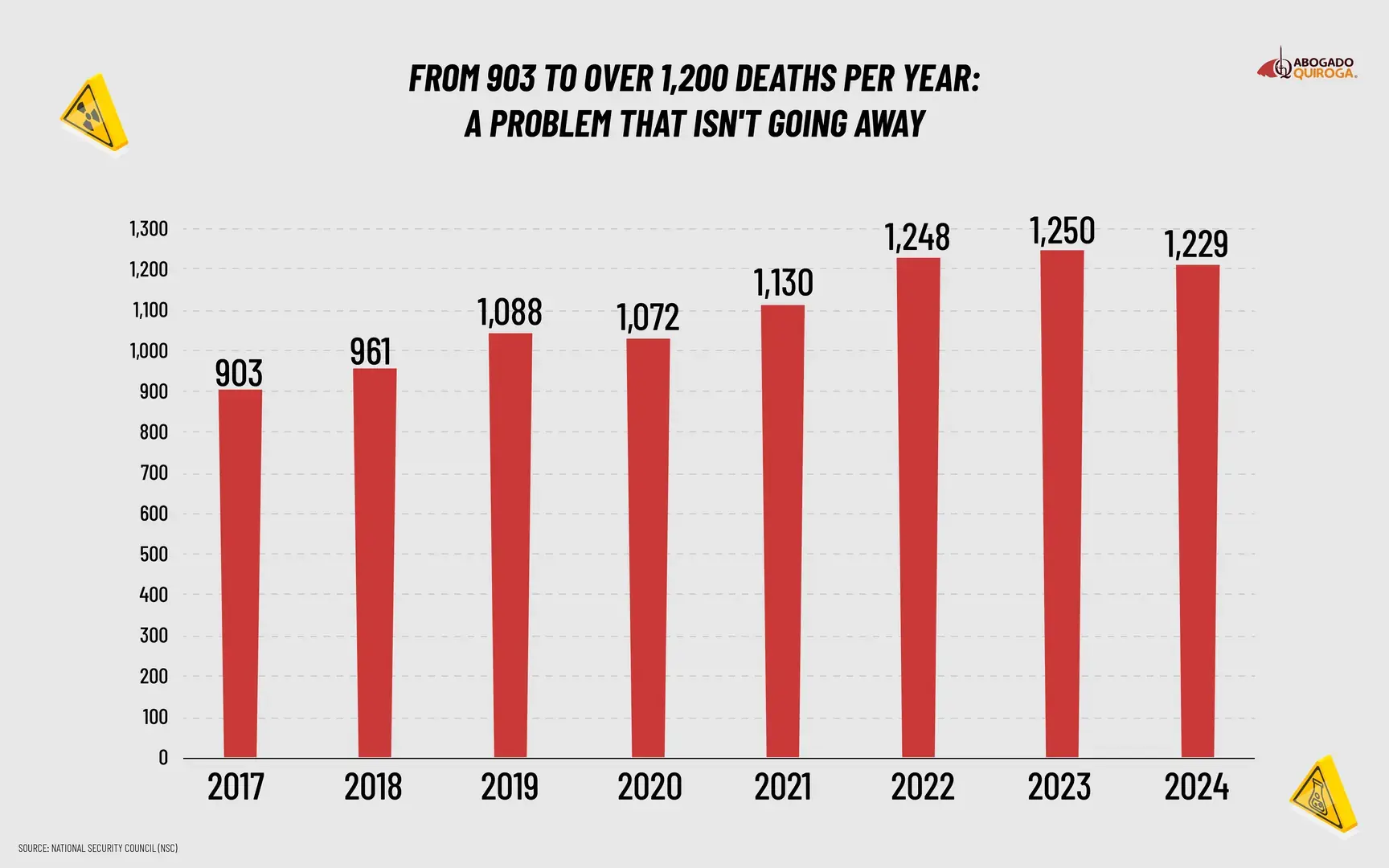
If we look at the data from the National Security Council (NSC) calmly, what it shows is not an improvement, but a problem that has persisted over time.
Between 2017 and 2019, Latino worker deaths increased by 13 %, reaching a thousand deaths in a single year for the first time. It was clear from that point on that something was wrong.
And although in 2020, during the pandemic period, deaths fell by 1.5 % to 1,072, in 2021 they rose again by 5.4% to 1,130, showing that the problem was still there.
In 2022 there was another sharp increase, again exceeding 10 % and reaching 1,248 deaths, one of the highest levels. Meanwhile, in 2023 and 2024 the numbers remained almost the same, with 1,250 and 1,229 deaths, respectively.
This makes one thing clear: the problem is no longer growing rapidly, but it's not getting better either. If we compare the beginning with the end, the difference is striking: in eight years, deaths rose from just over 900 to more than 1,200 per year, reaching a total of 8,881 deaths in eight years.
Where the risk occurs: the deaths that are repeated every day
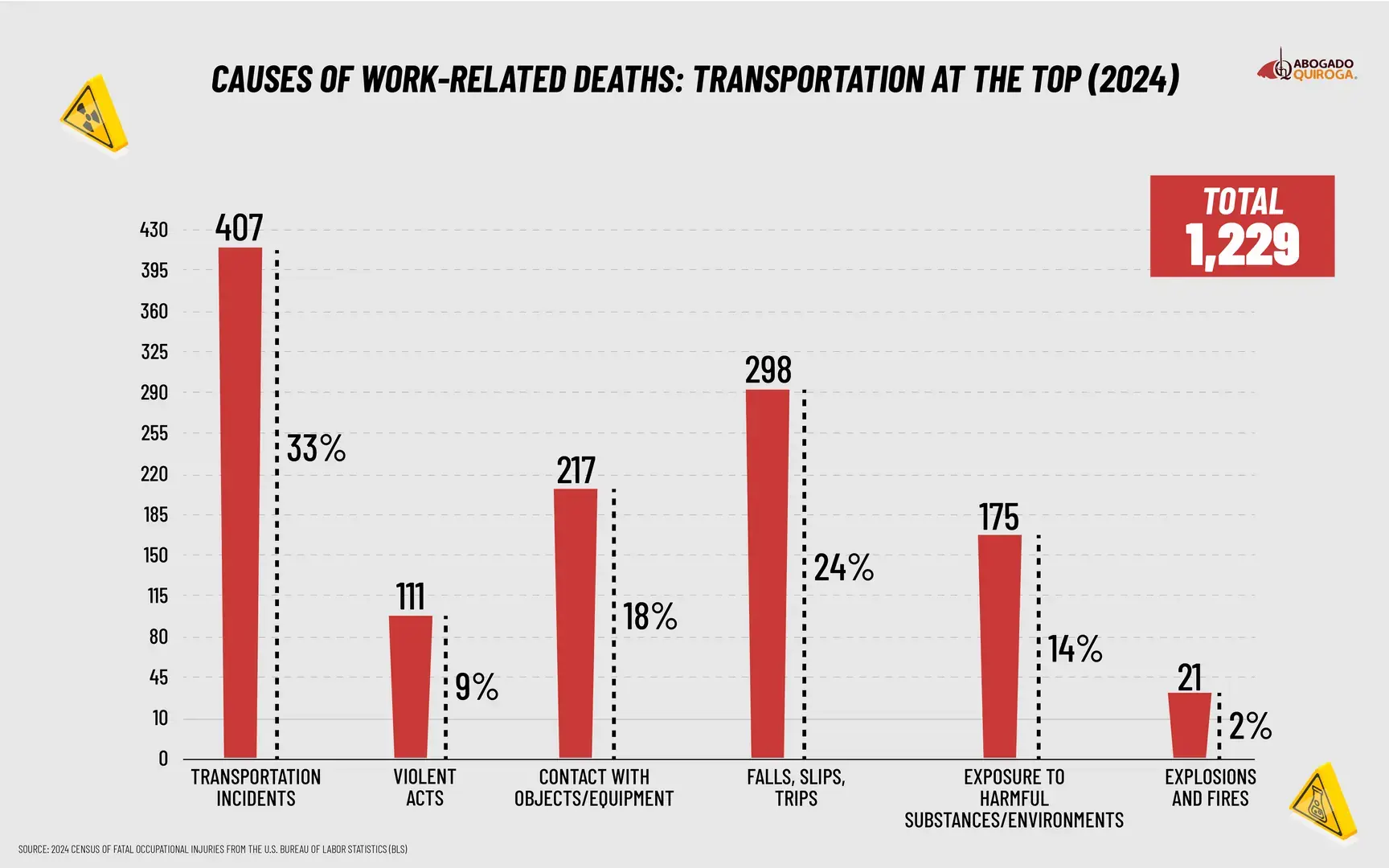
When we look at the causes of these deaths, the problem becomes even clearer and we can see that these are not isolated or uncommon accidents, but situations that are part of everyday life in many jobs.
The U.S. Bureau of Labor Statistics (BLS) 2024 Census of Fatal Occupational Injuries indicates that transportation incidents are the leading cause, with 407 deaths, representing approximately 33% of the total, meaning that one in three people die in situations related to vehicles or travel.
Secondly, there are falls, slips and trips, with 298 cases, about 24 %. These are very common accidents in physical work, especially in construction, and many times they could be prevented with better safety conditions.
Next comes contact with objects or equipment, with 217 deaths, which is equivalent to about 18 %. This includes accidents with machinery, tools, or heavy materials, which again highlights the risk in manual labor.
Exposure to harmful substances or environments accounts for 175 cases, approximately 14 %, while violent acts represent 111 deaths, close to 9 % and although they have a lower percentage with respect to the total, These data show that the danger lies not only in physical activity, but also in the work environment; explosions and fires, with 21 cases, represent about 2 %, being the least frequent cause, but no less serious.
Overall, the data shows that more than 75 % of deaths are concentrated in three main causes: transportation, falls, and contact with objects or equipment. However, most deaths occur in situations that are known, repeated, and, in many cases, preventable. These are not unpredictable accidents, but rather risks that are part of daily work and remain unresolved.
Now, if we examine the industries in which immigrants work, the picture is as follows:
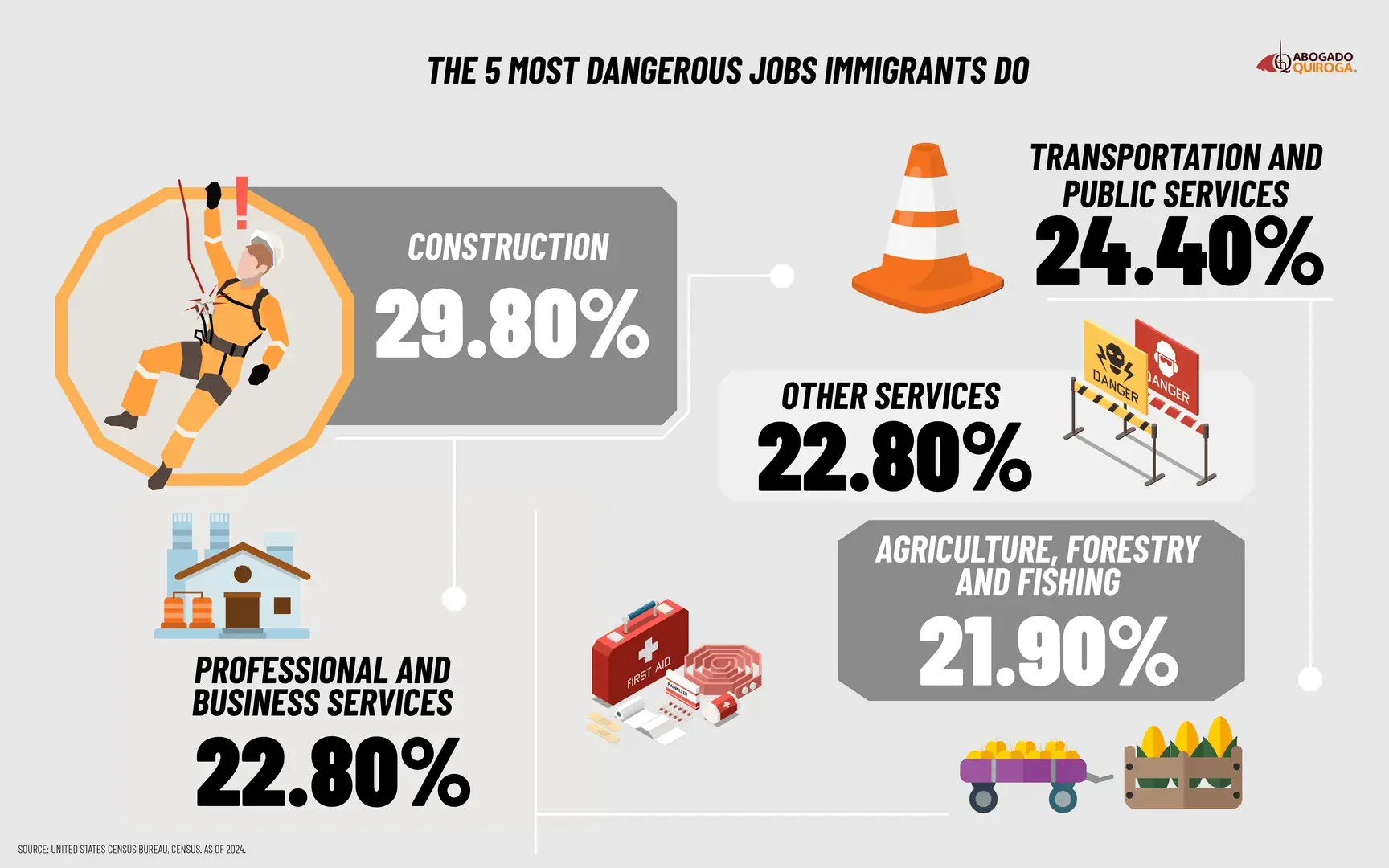
The most recent U.S. Census Bureau employment data, current as of 2024, reveals that immigrants are heavily represented in sectors such as construction with 29.8 %, the transport with 24.4 %, the agriculture with 21.9 % and manufacturing with 20.2 % and although the tables do not directly cross, the analysis developed allows us to deduce that the sectors in which there are more immigrant workers are also those where the most fatal types of accidents occur most frequently.
Construction, for example, is directly associated with falls and accidents with machinery; on the other hand, transportation is associated with road incidents, which are the main cause of death; agriculture and manufacturing, for their part, present risks such as exposure to machinery, hazardous substances, and demanding physical conditions.
It is important to clarify that this does not mean that all accidents occur only in these sectors, but it allows us to see that the risk is not distributed equally and that there are jobs where the probability of suffering a serious or fatal accident is higher ; precisely these are the spaces where a large part of the immigrant workforce is concentrated.
These data clearly show that the most dangerous jobs coincide with those where there is a greater presence of immigrant workers, which helps to explain why this population appears repeatedly in the figures for work-related injuries and deaths.
The risk is not decreasing and the data speaks for itself: more than 1,2 million injuries in 8 years: a risk that does not go down
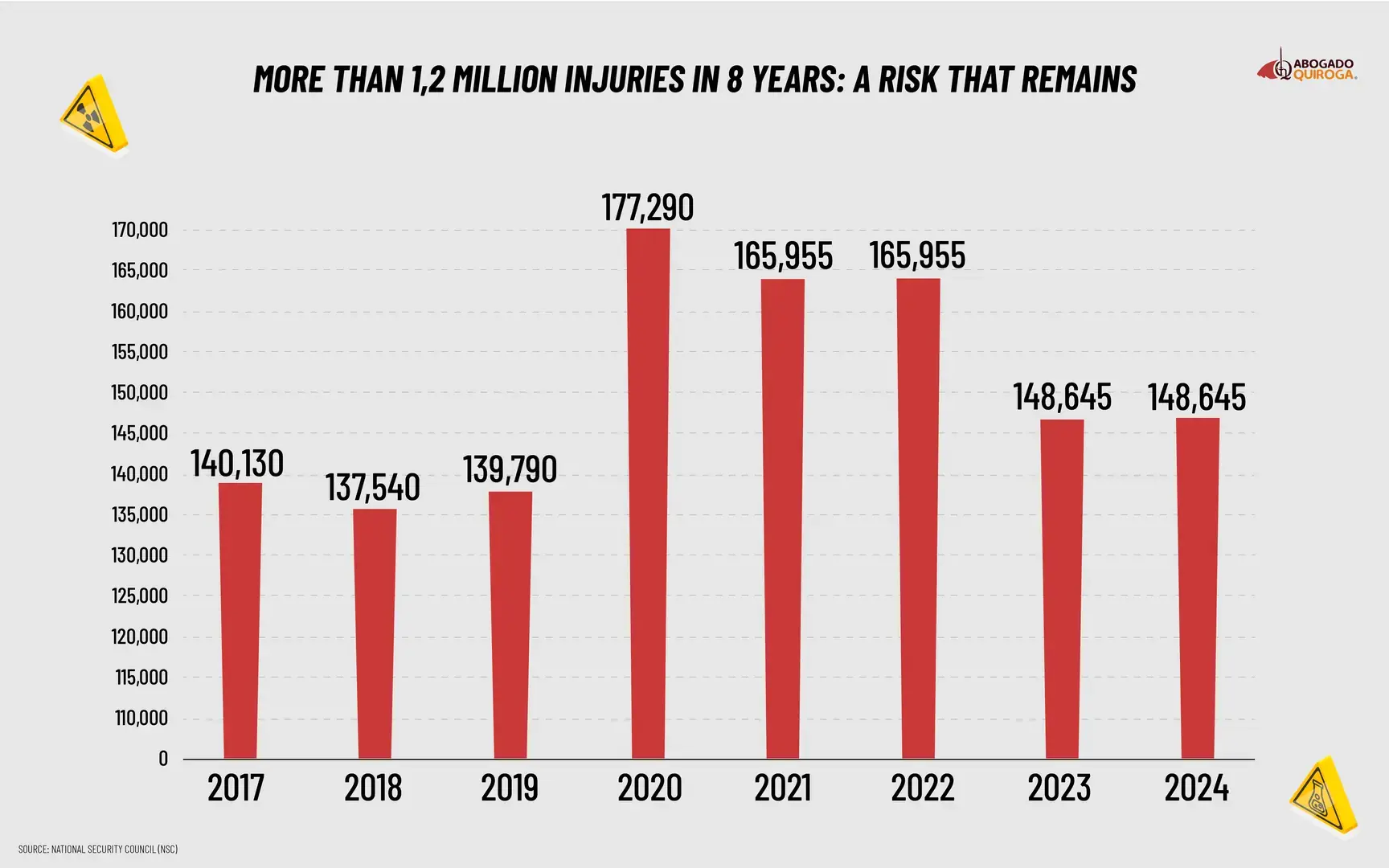
Non-fatal injuries that can leave lifelong scars on migrant workers reflect that they have remained relatively stable over the years, but with significant changes, according to the National Safety Council (NSC).
Looking at the overall trend over the years, cases went from 140,130 in 2017 to 148,645 in 2024, which shows that the problem has remained practically at the same level, without a significant reduction.
The most striking data is 2020, in which injuries skyrocketed by 27 %, reaching 177,290 cases, the highest point of the entire period analyzed, evidencing a critical moment, probably associated with changes in working conditions during that period.
After that peak, the figures drop, but not significantly, as they fall by 6 % in 2021, then stagnate (0 %) in 2022, and fall again by 10 % in 2023, reaching 148,645 cases, a figure that remains the same in 2024, which indicates that, although there was a decrease after the peak, the problem does not disappear, but remains.
What must be said is that the cumulative total is very high, and more than 1.2 million injuries in eight years show that this is a constant problem, which allows us to say that the risk factors at work, especially in sectors where there are more immigrants, remain unresolved.
Getting injured costs money: when the accident doesn't end at work
It is important to analyze that, for many immigrant workers, getting injured also means facing an economic crisis, because medical care demands resources that many of them do not have.
A recent study published in April 2026 in the Journal of the American Society for Surgery of the Hand, which analyzed nearly 4,000 cases of injuries at a trauma center in the United States, reveals what happens when an immigrant worker suffers a work accident.
Of all the cases reviewed, the majority were young men, with an average age of 36 years and almost 80 % worked in the construction sector, one of the riskiest sectors. Now, the distribution of coverage shows a clearly unequal structure in the financial burden of the system.
On the one hand, free care accounts for 50 % of cases (23 out of 46) and, at the same time, represents the highest total cost at over $2.2 million. This means that the public or subsidized system is absorbing half of the demand, but especially the most expensive cases, given their high average cost of $99,503. This implies that half of the people receiving care do not pay for it, yet this group still consumes the most money.
Direct payment, on the other hand, represents 35 % of cases (16), but with a much lower total cost reaching $531,706 and the lowest average cost at $33,231, which indicates that those who pay directly probably access more specific or less serious services, since high costs tend to exclude this type of coverage.
Workers' compensation is the least frequent group with 15 % of the total cases, (7 out of 46), but with a high average cost that reaches up to $73,055 and a total of $438,334 in total, which suggests that, although the events are less common, they tend to be associated with more serious or medically complex work injuries.
And this is where we can clearly see that workers' compensation for immigrant workers does not always work easily or fairly, and although in theory they have the right to receive support if they are injured at work, in practice they often do not get it because of the type of contract, whether the employment is informal or because of their immigration status.
Furthermore, many migrants work in harder or more dangerous jobs, which increases the risk of accidents, but at the same time, they often have less information or fewer resources to claim their rights, making it more difficult for them to receive the compensation they are entitled to. Therefore, in reality, this system is not always the same for everyone: it depends heavily on the type of work, whether the employment is formal, and whether the person knows or is able to demand their rights.
The invisible cost that sustains the system
Between 2017 and 2024, workplace deaths of Latino workers rose from 903 to 1,229 per year, a sustained increase that has not been reversed. Although the growth has stabilized in recent years, the problem persists, and each year more than a thousand immigrants lose their lives while performing some kind of job.
The most worrying aspect is that these deaths are not isolated incidents, as over 75 % are concentrated in three main causes: transportation incidents (33 %), falls (24 %), and contact with objects or machinery (18 %). These are known, recurring, and, in many cases, preventable risks. In other words, these are not unpredictable accidents, but rather the result of working conditions that have not improved sufficiently.
At the same time, immigrant workers are overrepresented in the most dangerous sectors; almost 30% in construction, more than 24 % in transport and close to 22 % in agriculture. This shows that the risk is not distributed equitably: those who sustain a large part of these industries are also those who face a greater likelihood of suffering serious or fatal accidents.
When the accident does not result in death, the economic impact is also high; medical care data reflects another inequality: 50 % of cases are treated free of charge, but they account for nearly 70 % of the total cost, exceeding $2.2 million, indicating that the public system ends up absorbing the most serious and costly cases.
In contrast, direct payments cover 35% of cases, but only a small portion of the total cost, suggesting that individuals can only afford lower costs. Meanwhile, workers' compensation, which should be the primary mechanism for workplace accidents, accounts for only 15 % of cases, highlighting real access difficulties for many immigrant workers.
After reviewing and analyzing all this data, one thing is clear: immigrant workers are not only more exposed to risk, but they also face greater barriers to receiving adequate protection and care. Thus, the cost of their labor is not measured solely in productivity, but also in lives lost, injuries, and an economic burden that often ends up being passed on to the public system.